A Guide to New Jersey’s Motor Vehicle Point System

When you’re pulled over for a traffic violation in New Jersey, the consequences can go far beyond paying a simple fine. The state’s detailed point system assigns penalties to your driving record that may result in license suspension, increased insurance premiums, and long-term financial consequences.

Even minor infractions can add up quickly. At Rosengard Law Group, we believe every driver deserves to understand how this system works and what legal options are available to protect their interests.
How New Jersey’s Point System Functions
New Jersey’s Motor Vehicle Commission (MVC) assigns points to your driving record for each moving violation conviction, with the number of points corresponding to the severity of the offense. When you’re convicted of a moving violation, points are added to your driving record, reflecting the seriousness of the offense and helping to monitor risky driving behavior.
The more points you accumulate, the more severe the consequences. These can include:
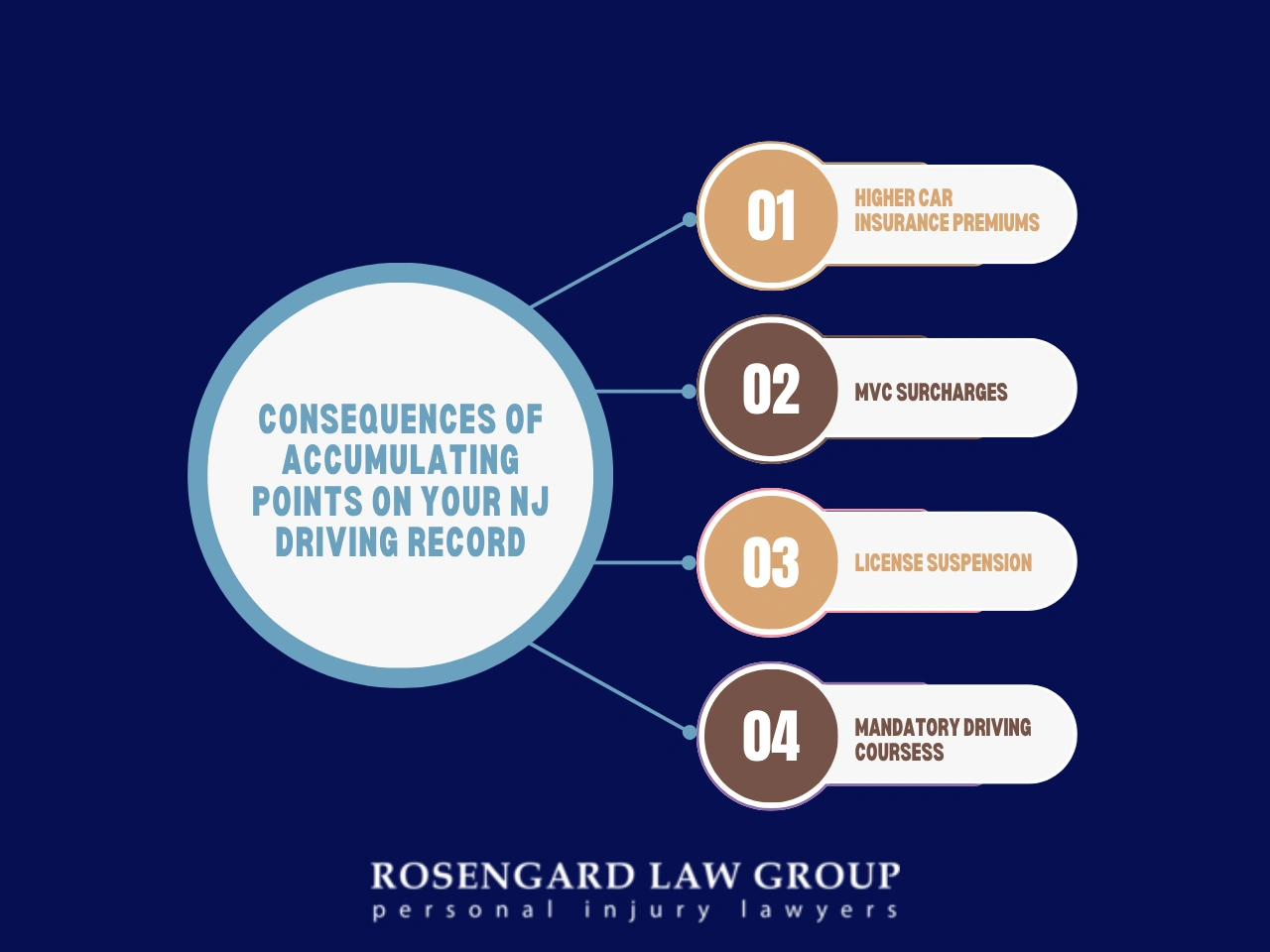
- Higher car insurance premiums
- MVC surcharges
- License suspension
- Mandatory driving courses
Unlike some states that focus solely on license suspension, New Jersey takes a multifaceted approach. The state uses your point accumulation to determine both administrative penalties and financial surcharges, creating a complex web of consequences that can catch drivers off guard.
What are the Common Violations and Their Point Values
The New Jersey point system assigns different values based on the nature and severity of each violation. Here’s a quick look at some other common violations and the points they carry under New Jersey law:
| N.J.S.A. Section | Violation | Poins |
|---|---|---|
| 39:4-98 | Speeding 1–14 mph over limit | 2 |
| 39:4-98 | Speeding 15–29 mph over limit | 4 |
| 39:4-98 | Speeding 30+ mph over limit | 5 |
| 39:4-96 | Reckless driving | 5 |
| 39:4-89 | Tailgating | 5 |
| 39:4-97 | Careless driving | 2 |
| 39:4-81 | Failure to observe traffic signals | 2 |
| 39:4-115 | Improper turn at traffic light | 3 |
| 39:4-90 | Failure to yield at intersection | 2 |
| 39:4-85 | Improper passing on right or off roadway | 4 |
| 39:4-66.2 | Driving on private property to avoid signal | 2 |
These points are added after a conviction, not just after receiving a ticket. That’s why it’s important to understand your rights and consider fighting a ticket if the consequences are serious.
How Points Affect You
Insurance companies use your driving record to determine your risk level. More points usually mean higher premiums. Even a few points can cause your rates to jump significantly.
If you accumulate 6 or more points within 3 years, the MVC will charge you a surcharge. This is an extra fee you must pay annually for three years. For example:
- 6 points = $150 surcharge
- Each additional point = $25 more
These fees are separate from any fines or court costs. Reaching 12 or more points on your record will result in license suspension, meaning you won’t be allowed to drive until you complete certain requirements, such as attending a driver improvement program or serving a suspension period. To better understand how your driving violations are categorized, refer to this guide on New Jersey auto insurance codes.
How to Reduce Points on Your License
The good news is that points don’t stay on your driving record forever, and there are several ways to reduce them. If you go one full year without any violations or license suspensions, the New Jersey Motor Vehicle Commission (MVC) will automatically deduct three points. You can also take a state-approved defensive driving course to remove two points, which is allowed once every five years.
If you’re referred by the MVC due to excessive points, completing a driver improvement program may help lower your total and prevent a potential license suspension, giving you a chance to improve your record.
How Can a Lawyer Protect Your Driving Privileges in NJ?
New Jersey’s point system is complicated, but it’s also predictable once you understand how it works. The key is taking violations seriously from the beginning rather than hoping they’ll simply disappear. Whether you’re facing your first traffic ticket or dealing with multiple violations, understanding the system empowers you to make informed decisions about your legal strategy.
At Rosengard Law Group, we’re here to help you address these challenges and protect your driving privileges. Every case is unique, and every driver deserves representation that understands both the law and the real-world consequences of traffic violations.
Don’t let traffic violations derail your driving future. Contact our experienced Cherry Hill auto attorney team today to discuss your specific situation and learn how we can help protect your rights and rights on New Jersey’s roads.
FAQs
How long do points stay on my record in New Jersey?
Points stay on your record permanently, but they stop affecting your driving status after a certain time. You can reduce points by going one year without violations or taking approved courses.
Can I fight a traffic ticket to avoid points?
Yes. You can challenge a ticket in municipal court. A lawyer can help you reduce or eliminate points by negotiating or proving your innocence.
What happens if I reach 12 points?
Your license may be suspended. You’ll need to complete a driver improvement program or serve a suspension period before driving again.
Can I receive points for an out-of-state ticket?
Yes. New Jersey adds 2 points to your record for any out-of-state moving violation, regardless of the offense.
Can I remove points by taking a defensive driving course?
Yes. You can remove 2 points by completing a state-approved defensive driving course once every five years.
Get a Free Consultation
The use of the Internet or this form for communication with the firm or any individual member of the firm does not establish an attorney-client relationship. By submitting, you agree to our
Privacy Policy.


